Jan 19, 2026
British Farmers’ Interest and Motivation in Climate Change Adaptation and Mitigation
Climate Spheres previous 2 blogs in this series explored what the ECIU’s 2025 report, The Impact of Climate Change on British Farms and Farmers’ Mental Health, tells us about British farmers’ experience of extreme weather, both physically and emotionally. In this final installment, we consider aspects of the study that explore farmers’ willingness to engage with climate change adaptation and mitigation measures, and their confidence in related policies such as Net Zero.
The survey revealed that farmers are being proactive in the face of increases in extreme weather. 68% of farmers have altered their practices due to extreme weather, with two thirds having changed planting or harvesting schedules and about half having adjusted livestock management. These adaptations demonstrate resilience and flexibility, showing that farmers are willing to take a dynamic approach to their businesses in order to safeguard profitability in a changing world.
However, despite increasing awareness of the range of climate change mitigation and adaptation options that are beneficial to farms, uptake is below what is needed. Farmers identified better farmgate prices (66%), long-term policy certainty (59%), and higher payments (54%) as key motivators for the adoption of climate-friendly practices. This highlights the central role of financial sustainability in enabling businesses to practice environmental sustainability.
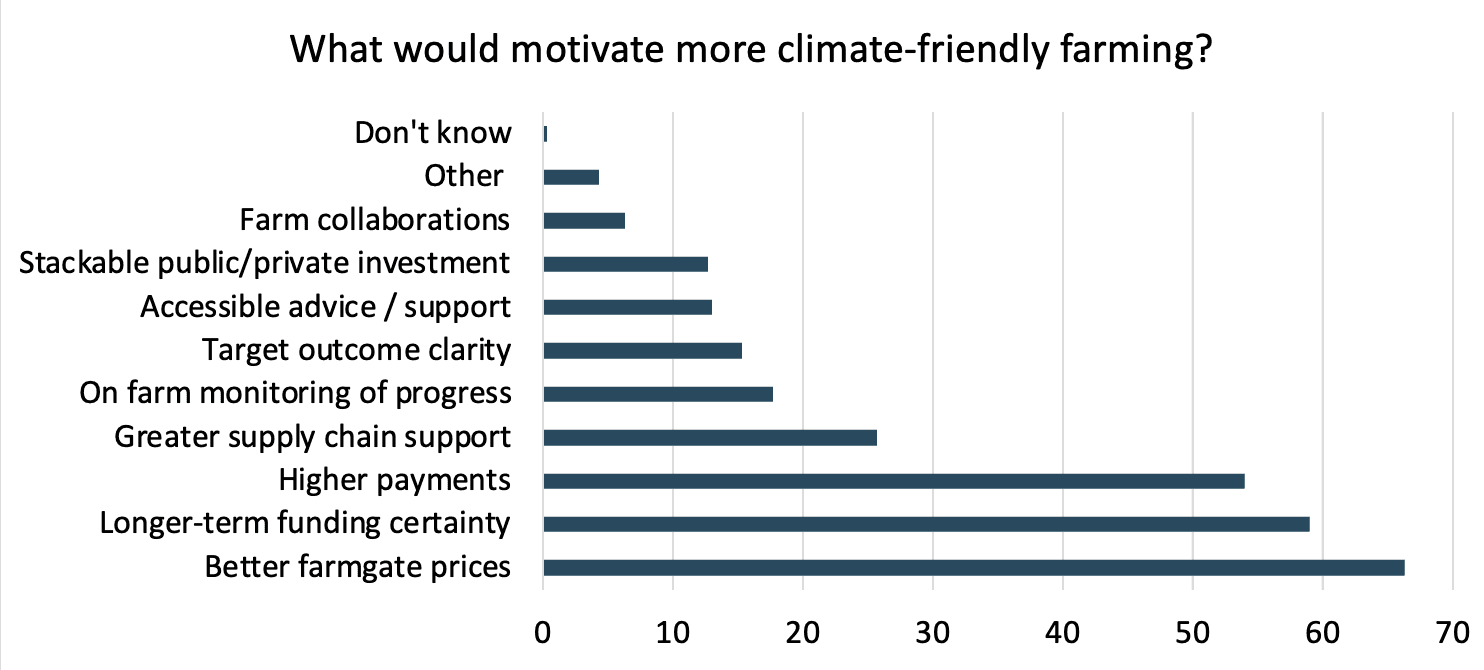
Figure above: In response to the survey question: “What would encourage you to do more for climate and nature outcomes on your farm? Select up to three.”
In analysing responses, we considered farmers long history of distrusting agricultural policy and political intent. The controversies around the introduction of the Sustainable Farming Incentive (some legitimate and some contrived) and changes to inheritance tax rules have further eroded trust, with ‘government policy’ being a cause of anxiety among farmers. It is therefore not surprising that attitudes toward Net Zero are mixed. Only 40% of farmers support the UK’s 2050 Net Zero target (compared to 66% of the general public) with a similar percentage being against the policy and only 20% being neutral. Interesting, 35% believe climate change can be stopped without the world reaching Net Zero, which suggests that farmers’ doubts may be directed specifically at government policy (only 34% thought the Net Zero policy was necessary).
The survey found that 55% of farmers agree that addressing climate risks is a priority, even if it means changing farming practices. This suggests openness to adaptation when framed around resilience rather than emissions. Farmers showed interest in engaging in a broad range of environmentally-beneficial alternative land uses: 63% were interested in cover crops, 49% in hedgerows, and 60% in habitat creation like wildflower margins. These steps can protect against soil erosion, floods, and heatwaves while boosting biodiversity within a productive farming environment.
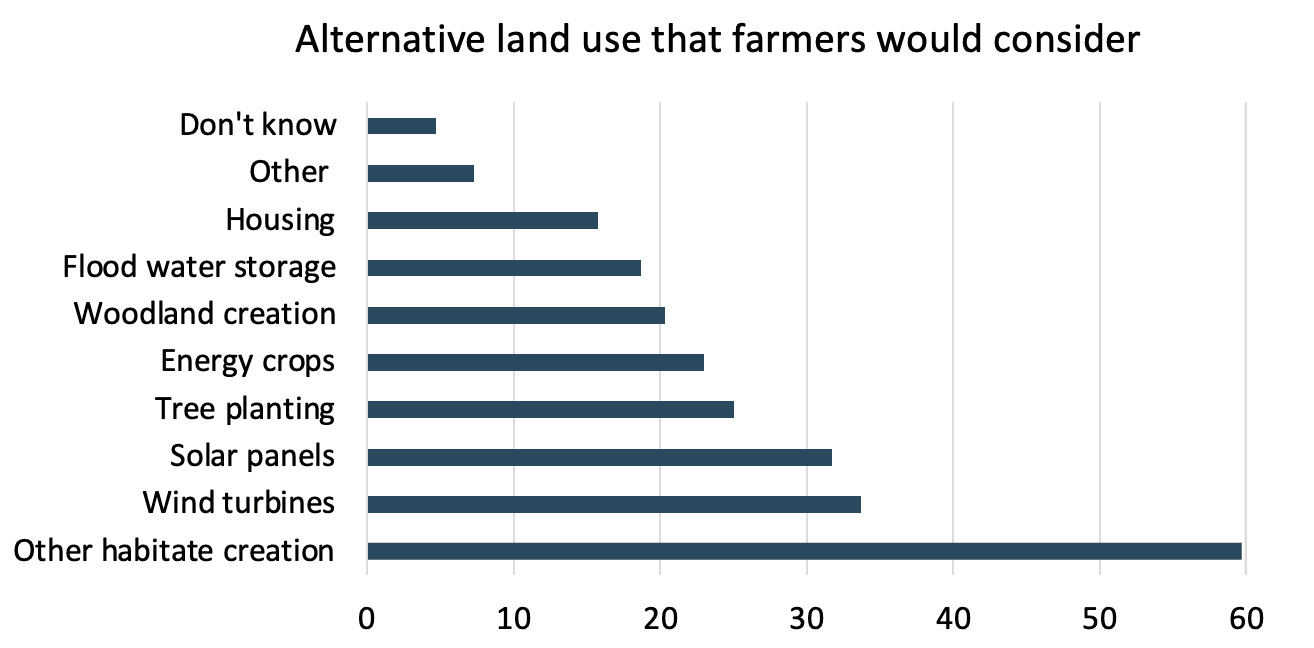
Figure above: In response to the survey question: “Would you consider using some of your farmland for one or more of the following, given the right incentives? Select up to three.”
In response to the survey question: “Would you consider using some of your farmland for one or more of the following, given the right incentives? Select up to three.”
The report calls for two key actions. First, immediate mental health support is essential, with organizations like RABI playing a critical role, especially given high suicide rates in the sector. Second, long-term climate policies, such as stable ELM schemes, can reduce the burden of extreme weather by funding measures like tree planting or soil health improvements. These not only enhance farm resilience but also provide financial certainty and could increase faith in agricultural policy.
At Climate Spheres, we use farm-level climate change risk assessments and Life Cycle Assessment to understand what adaptation and mitigation strategies make the most sense for individual farms, and enable both environmental and financial sustainability. Contact us today to learn more.
Authored by: Rosalind Haskins, PhD, Climate Spheres Research Director LinkedIn: linkedin.com/in/rosalind-haskins
Source Report